
Vinyl records · Complete Guide
Buy Japanese Vinyl Records from Japan: Overseas Collector Guide
From the global city-pop revival to coveted anime and video-game soundtracks, Japanese pressings are some of the most sought-after vinyl in the world — prized for sound quality and artwork. Here’s the complete 2026 guide to buying them from abroad.
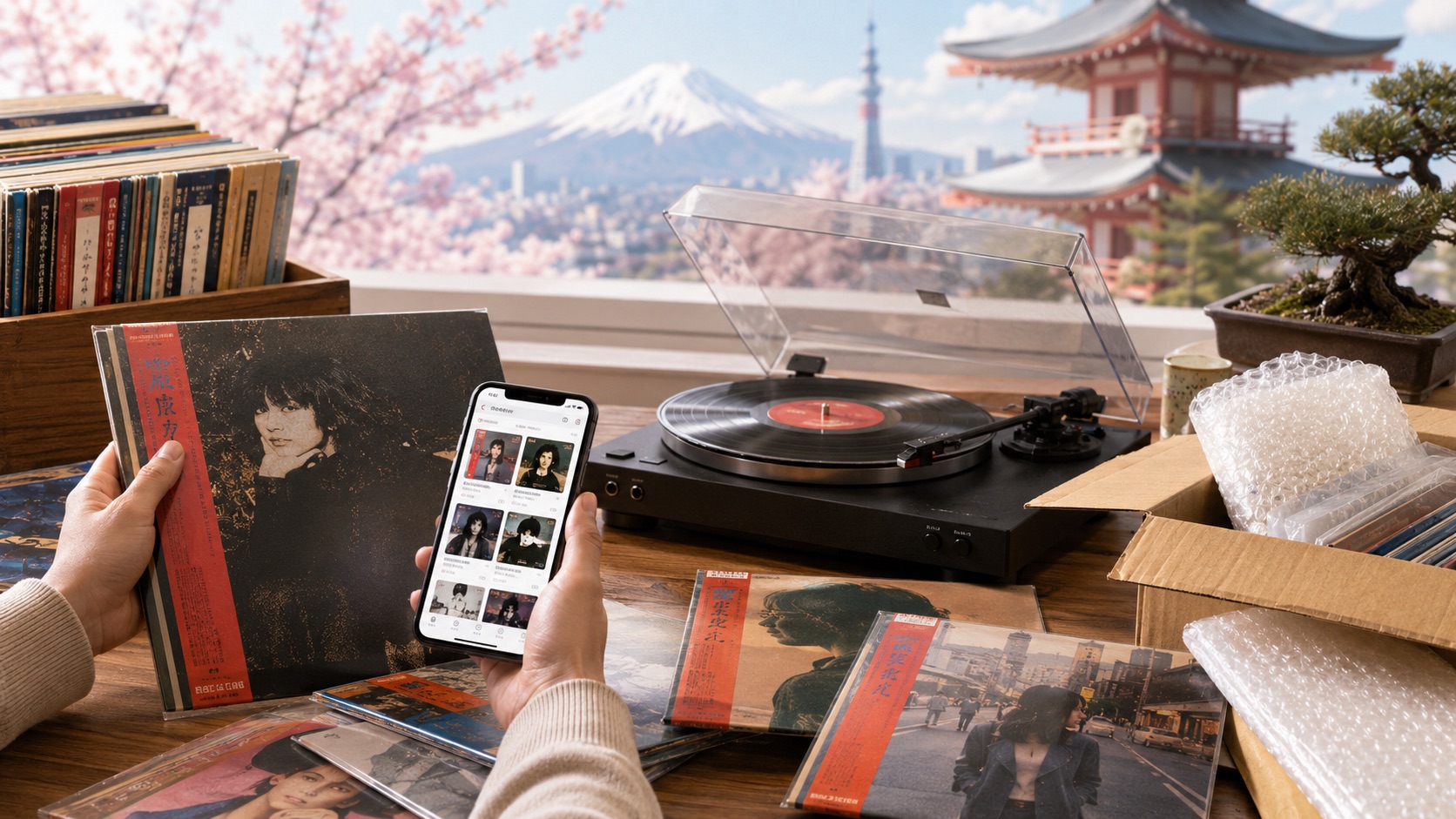
Why Japanese pressings are prized
Japanese records have a strong reputation among collectors for pressing quality (quiet surfaces, careful mastering) and for the care that went into packaging — heavyweight jackets, inserts, lyric sheets and the distinctive OBI strip. Many Western albums also got unique Japanese editions with different artwork or bonus tracks. Combined with the global hunger for Japanese music itself, that makes Japan a top destination for serious diggers.
Hot genres
- City pop — the late-70s/80s sound (Tatsuro Yamashita, Mariya Takeuchi and peers) that went viral worldwide; original pressings are highly sought.
- Anime & video-game soundtracks — OSTs and image albums, many never released abroad.
- Japanese jazz & fusion — a deep, collectible scene with rising prices.
- Japanese editions of Western albums — unique art, OBIs and inserts.
The OBI strip — and why it matters
The OBI (帯, “obi”) is the printed paper strip wrapped around the spine of a Japanese record, carrying the title, price and marketing text. Because it’s loose paper, it was usually thrown away — so a record that still has its original OBI is markedly more collectible and valuable than the same record without it. When buying, always check whether the OBI is present and intact, and ask for a photo of it. “帯付き (obi-tsuki)” means it’s included.
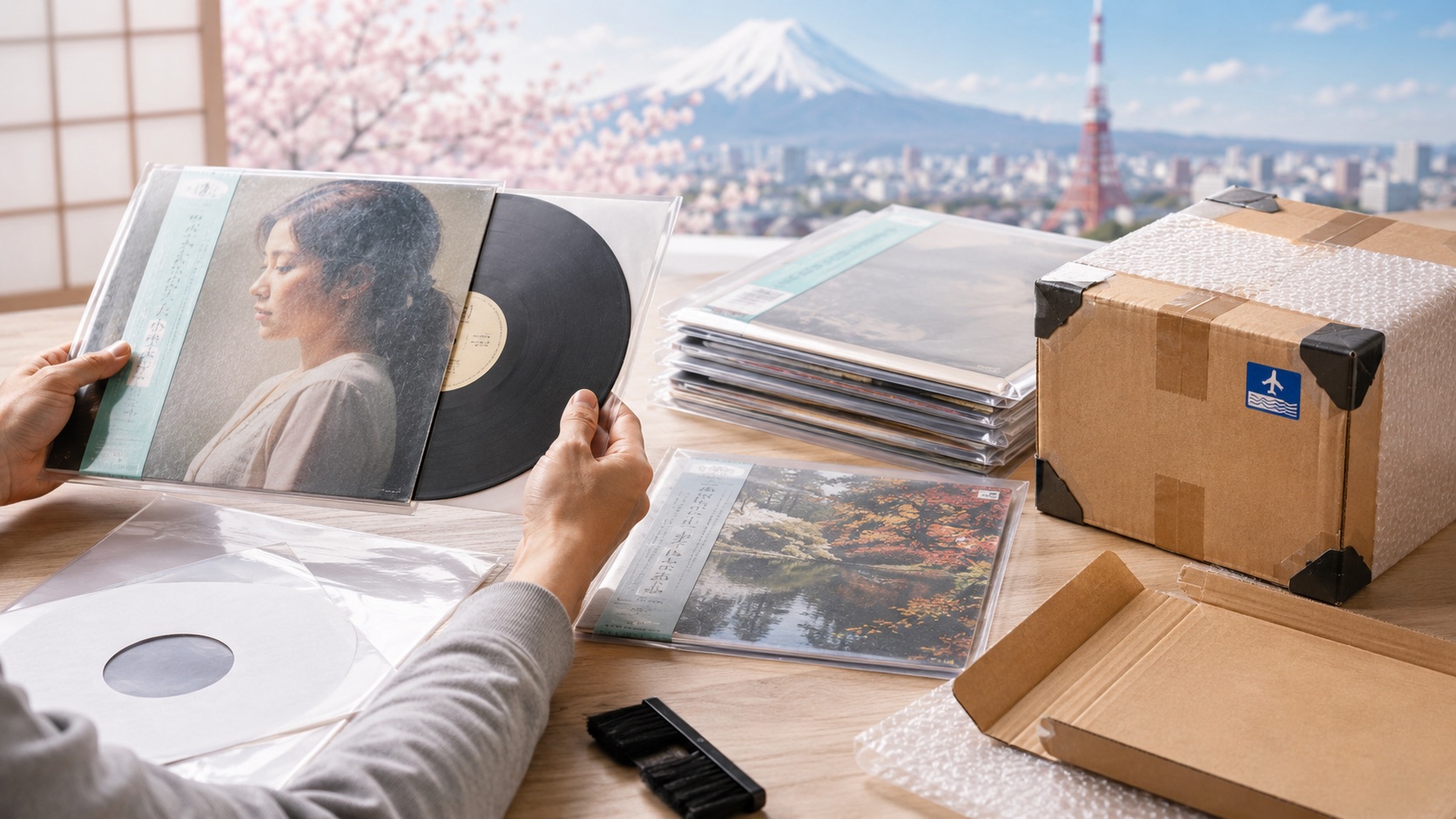
Reading condition grades
Japanese sellers often grade the record and the jacket separately, mixing Japanese terms with the international Goldmine-style scale (M, NM, EX, VG…):
| Term | Meaning |
|---|---|
| 盤 (ban) | The record/disc itself |
| ジャケット / ジャケ | The cover/jacket |
| 美盤 (biban) | Beautiful disc, minimal marks |
| 帯付き (obi-tsuki) | Includes the original OBI strip |
| EX / NM / VG+ | Standard grading (Excellent / Near Mint / Very Good+) |
| スレ / 傷 | Scuffs / scratches |
| 反り (sori) | Warping — ask, as it affects playback |
Ask whether the grade is visual or play-tested, and request close-ups of the disc surface under light, plus the jacket corners and seams.
Will it play on my turntable?
Yes. Vinyl is not region-locked and uses the same 33⅓ and 45 RPM standards worldwide. The only quirk: some Japanese 7-inch singles have a large center hole and need a cheap 45 adapter. Otherwise, a Japanese LP plays on any standard turntable.
Shipping records safely, cost & customs
Total cost = item price + (domestic shipping) + proxy fee + optional services + international shipping + possible customs. Records are flat but heavy and fragile — they can warp in heat and crush at the corners. Best practice:
- Ship in a proper record mailer with stiffeners; the disc removed from the jacket to prevent seam splits (or carefully secured).
- Corner protection and a “do not bend” approach.
- Avoid leaving parcels in heat to prevent warping.
- Consider consolidating multiple records into one well-built box.
Customs duties apply on arrival depending on your country and declared value.
Originals vs reissues: how to tell
For collectible titles, an original first pressing can be worth many times a later reissue — so confirming which one you’re buying is essential. The clues live in the details:
- Catalogue number — printed on the spine, jacket and label; original and reissue runs use different numbers. Match it against a discography.
- Matrix / runout (dead wax) — the etched codes in the run-out groove near the label identify the specific pressing; ask the seller for a close-up.
- Label design — record labels changed their logo and layout over the years, so the label style hints at the era.
- OBI text and price — the OBI often shows a yen price and catalogue code tied to a particular release.
- Jacket details — reissues sometimes add a barcode, a “再発” (reissue) note, or updated credits.
A reissue isn’t “bad” — modern remasters can sound excellent and cost far less — but you should pay reissue money for a reissue, not original-pressing money. If a listing’s price implies an original, ask for photos of the runout, label and OBI to confirm before buying. A proxy can request these and relay the catalogue number for you.
Hunting an original-OBI pressing?
Get a free quote and have a person confirm the OBI and grading before you buy.
Get a free quoteFrequently asked questions
Will Japanese records play on my turntable?
Yes — vinyl isn’t region-locked and uses standard 33/45 RPM. Some 7-inch singles have a large center hole and need an adapter.
What is an OBI strip and why does it matter?
The OBI (帯) is the paper band around a Japanese record. It’s easily lost, so a record that still has it is more collectible and valuable.
Why is city pop vinyl so popular?
City pop saw a global revival, and original Japanese pressings are prized for sound quality and artwork, driving strong overseas demand.
How should records be shipped?
Flat, in a stiffened record mailer with corner protection, ideally kept out of heat to avoid warping. Consolidating multiple records helps.