
Gunpla & model kits · Complete Guide
Buy Gunpla from Japan: Proxy Guide for Overseas Builders
Japan is the home of Gunpla — Bandai’s Gundam plastic model kits — and the cheapest, deepest source for everything from entry-level grades to sold-out P-Bandai exclusives. Here’s the complete 2026 guide to buying them from abroad, understanding the grades, and shipping kits safely.
Why buy Gunpla from Japan
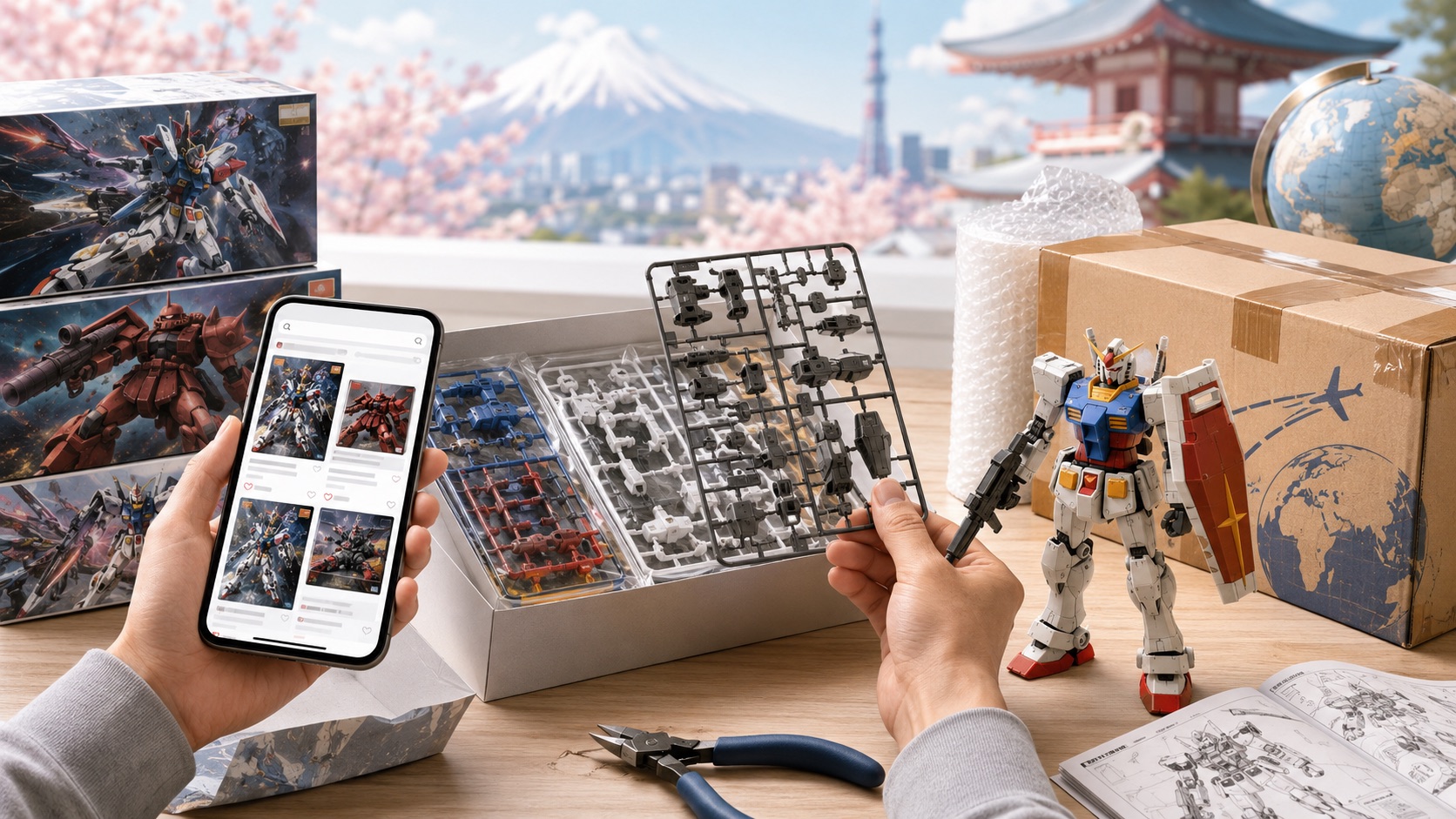
Three reasons. Price: Bandai manufactures Gunpla in Japan and sells at domestic retail, so standard kits are usually cheaper at the source than imported copies. Availability: many kits — especially online exclusives and older releases — simply aren’t distributed abroad, or sell out instantly when they are. Selection: the full back catalogue, campaign kits, clear/metallic variants and event exclusives all surface on Japanese marketplaces. For anything beyond the current mass-retail lineup, Japan is where you actually find it.
Gunpla grades explained
Gunpla is organized by “grade,” which describes scale, complexity and price — not quality ranking. Knowing the grade tells you what you’re buying:
| Grade | Scale | Best for |
|---|---|---|
| Entry Grade (EG) | 1/144 | Beginners; few parts, no tools needed |
| High Grade (HG) | 1/144 | The everyday standard; huge range, affordable |
| Real Grade (RG) | 1/144 | High detail in a small size; more advanced |
| Master Grade (MG) | 1/100 | Inner frame, great detail; the enthusiast favorite |
| Perfect Grade (PG) | 1/60 | Largest, most complex and expensive; centerpieces |
| SD / others | non-scale | Super-deformed chibi kits; fun, cheap |
If you’re new, start with HG or EG. Collectors chasing display pieces gravitate to MG and PG — which are also the kits where Japan’s pricing advantage is largest.
P-Bandai and limited kits — the real reason to use a proxy
P-Bandai (Premium Bandai) is Bandai’s online-exclusive store for limited-run kits not sold in regular shops — alternate color schemes, expansion sets, and obscure mobile suits. These are made in limited quantities, sell out fast, and are notoriously hard to buy from outside Japan. Once gone, they reappear only on the secondhand market at a premium.
This is precisely where a proxy earns its keep: it can buy a P-Bandai or sold-out kit from a Japanese marketplace and forward it to you, often well below the inflated prices charged by overseas resellers. If you collect seriously, P-Bandai access is the single biggest practical benefit of buying through Japan.
Where Gunpla is sold
- Mercari Japan — vast supply of sealed and built kits at fixed prices.
- Yahoo Auctions — rare, vintage and bulk lots; auction format.
- Rakuma — similar to Mercari, sometimes cheaper.
- Hobby retailers’ online shops — new stock, including some exclusives.
New vs used: what to check
For a hobby that involves assembly, “condition” means different things depending on whether the kit is sealed:
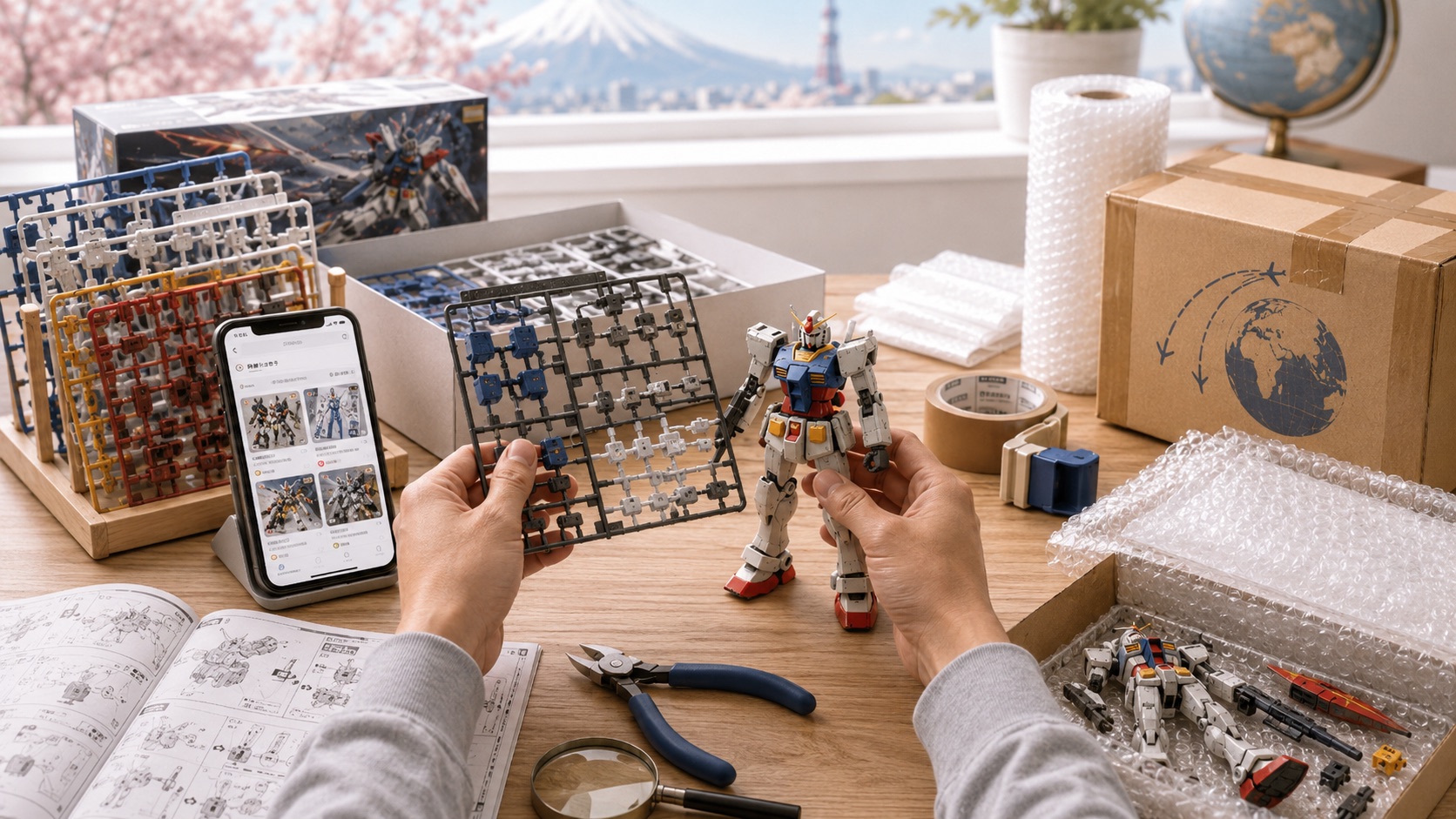
- 新品・未組立 (new, unbuilt) — ideal; confirm the box and that the seal/runners are intact.
- 組立済み (built) — already assembled; ask whether it was glued, painted, or has panel lines/decals applied, and whether all parts and the manual are included.
- 外箱傷み (box damage) — matters to collectors of sealed kits; ask for photos of corners and edges.
- 欠品 (missing parts) — for used or part-built kits, confirm nothing is missing, including spare runners, stickers and instructions.
Genuine Bandai vs bootleg kits
Unofficial “knock-off” kits (often called KO or by brand names from outside Japan) exist and are sometimes sold misleadingly. Buying from Japan overwhelmingly means genuine Bandai, but stay alert:
- Box printing — genuine Bandai boxes have crisp printing and proper logos/copyright lines.
- Price — a “new” sought-after kit far below market can signal a KO or a problem.
- Plastic and engineering — bootlegs often have softer plastic, looser fit and worse molding.
- Seller rating — favor established sellers for expensive or exclusive kits.
Shipping, cost and customs
Total cost = kit price + (domestic shipping) + proxy fee + optional services + international shipping + possible customs. Kits are light but boxes are bulky, so volumetric (dimensional) weight often drives the shipping price — a PG box ships very differently from a flat HG box. If you buy several kits, a service that can consolidate them into one parcel saves a lot. Customs duties apply on arrival depending on your country.
Tools & tips for first-time builders
Part of Gunpla’s appeal is that modern kits are snap-fit — they don’t require glue or paint, so you can build a great-looking model with almost nothing. A few basics dramatically improve results:
- Side cutters (nippers) — the one essential tool; a sharp pair leaves clean cuts with minimal nub marks. Bandai’s own nippers and the well-known God Hand brand are popular and, like the kits, cheaper in Japan.
- Hobby knife & sanding sticks — for trimming and smoothing leftover nubs.
- Panel-lining pen — running a fine liner into recessed lines adds depth instantly; the easiest “pro” upgrade.
- Decals — kits come with stickers and/or waterslide decals; waterslides look better but take patience.
- Top coat — an optional matte or gloss spray unifies the finish and protects decals.
If you’d rather skip assembly, you can buy a pre-built or painted kit from a Japanese marketplace — but inspect closely. Ask whether it was hand-painted or panel-lined, whether decals are applied, and request close-ups of joints for stress marks. A beautifully painted commission can be a bargain; a roughly snapped, nub-scarred build usually isn’t worth a premium. When in doubt, a sealed kit you build yourself is the safest value.
Chasing a sold-out P-Bandai kit?
Get a free quote and have a person track it down and check it before you buy.
Get a free quoteFrequently asked questions
Are Gunpla cheaper in Japan?
Usually yes — Bandai makes them in Japan and sells at domestic retail, so standard kits are typically cheaper at the source, especially HG, RG and MG.
What is P-Bandai and why is it hard to get?
P-Bandai kits are online-exclusive, limited-run releases not sold in normal stores. They sell out fast and are hard to buy outside Japan, which is why collectors use a proxy.
Do Gunpla kits have region or import restrictions?
No electronics means no region lock. They ship internationally easily, though large boxes can be priced by volumetric weight.
Should I buy sealed or built kits?
Sealed kits are safest and best for collectors and builders. Built kits can be cheaper but confirm parts, gluing, painting and nub damage first.